
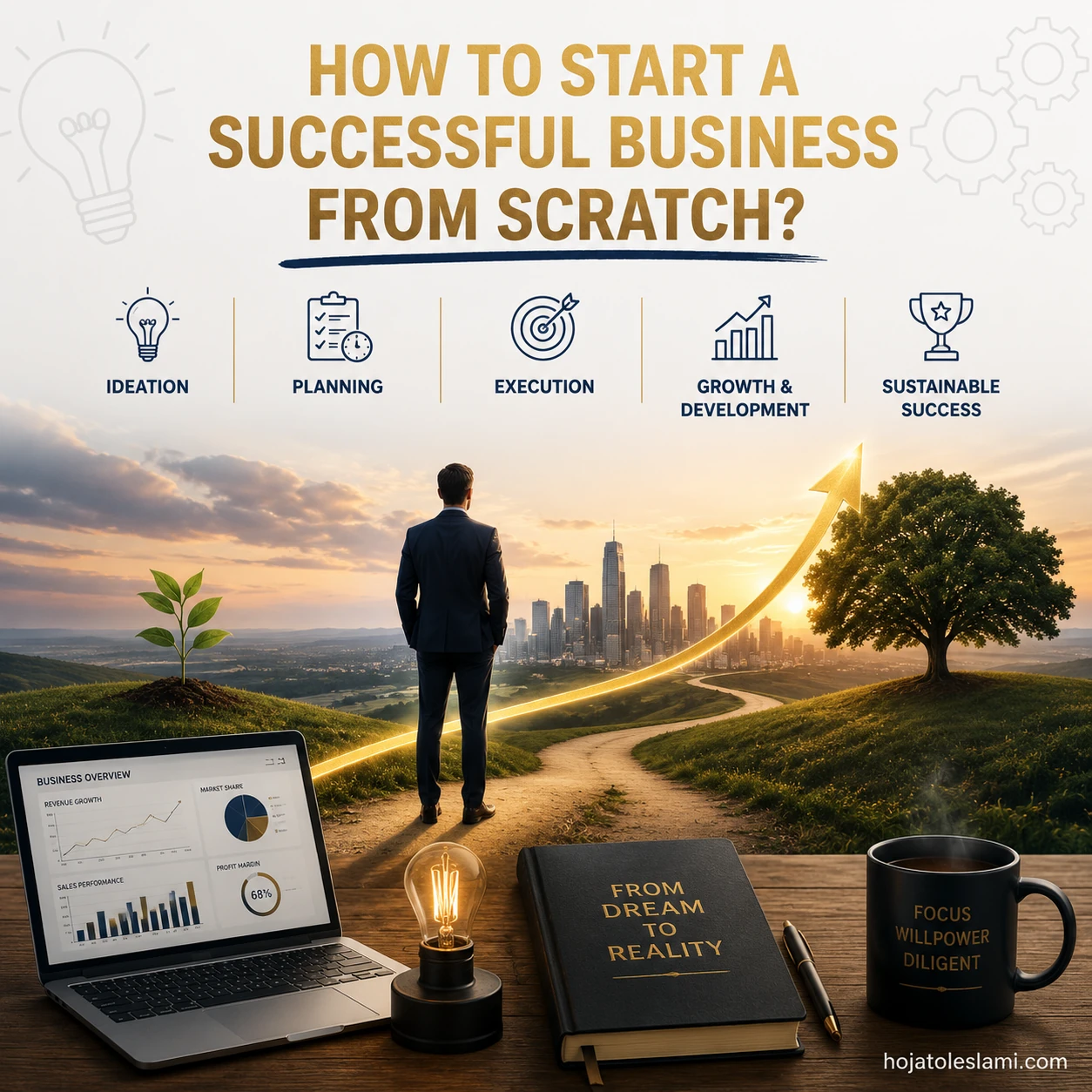
How to Start a Business from Scratch: A Complete, Practical, and Professional Guide
Starting a business from scratch is not only a financial decision; it is a strategic decision to build a more independent, flexible, and controllable future. Many people dream of having their own business, but they get stuck between ideas, fear of failure, limited capital, lack of clarity, and uncertainty about where to begin. If you want to know exactly how to start, how to choose the right idea, how to reduce risk, and how to turn a simple beginning into a real business, this guide is for you.
This is not just a motivational article. This guide is designed to walk you through the real foundations of building a business: the right mindset, idea selection, market validation, budgeting, branding, marketing, sales, operations, team building, and sustainable growth. If you want to build something that lasts beyond a few weeks of excitement, this roadmap can become a practical starting point.
1. The Right Mindset for Starting a Business
Before tools, money, branding, or marketing, you need the right mindset. Many people believe that business success comes only from a great idea or a large amount of capital. In reality, your mindset determines how you handle uncertainty, pressure, delayed results, feedback, and difficult decisions. Starting a business always includes unknowns. You will not know everything at the beginning, and that is completely normal.
A professional entrepreneur is not someone who has all the answers from day one. A professional entrepreneur is someone who makes the best possible decision with the available information, takes action, collects feedback, improves the offer, and repeats the process. If you wait for perfect conditions, you may never start. The first skill of business building is the ability to move forward with imperfect information.
The ability to adjust your direction without losing your main focus.
The discipline to keep moving even when results are not immediate.
Turning mistakes and feedback into practical improvements.
⚠️ Dangerous belief: “Everything must be ready first.”
This belief stops many people before they even begin. Most successful businesses started with an early, imperfect, but usable version. Starting small, learning fast, and improving continuously is often much better than waiting too long to launch a perfect version.
2. Why Build Your Own Business?
Building a business is not suitable for everyone, but for many people it can be one of the best paths toward financial and professional growth. A business is not only about earning more money. It is about building an asset, gaining more control over your time, creating value, making independent decisions, and developing skills that can compound over years.
Of course, this path comes with more responsibility. You exchange the mental comfort of fixed income for uncertainty, risk, and pressure. But in return, your growth is no longer limited by a fixed salary or a predefined job title. In 2026, digital tools, AI, automation, online platforms, and remote work have made it easier than ever to start lean and build real businesses with fewer resources.
- More independence
- Scalable income
- Personal or business brand
- Control over decisions
- Real value creation
- Unlimited growth potential
3. How to Choose the Right Business Idea
One of the most common questions is: “What business should I start?” The answer is not necessarily the strangest or most original idea. The best business idea usually sits at the intersection of market demand, your skills, and your genuine interest. If an idea is trendy but you have no knowledge or interest in it, you may lose motivation quickly. If you only follow passion without market demand, the business may not survive.
Practical sources for finding business ideas
- Problems you or people around you repeatedly experience
- Weak services in the market that can be improved
- Skills you already have that people are willing to pay for
- Growing trends such as education, health, technology, digital content, automation, and specialized services
- Local markets that have not yet become fully digital
- Social media management and content creation services
- Niche e-commerce store
- Selling digital products, templates, courses, or downloadable files
- Freelancing in design, writing, translation, advertising, or programming
- Consulting or coaching in a specialized skill area
- Local services such as packaging, decoration, beauty, photography, or technical repairs
4. Validating Your Idea Before Spending Money
Validation means checking whether the market actually wants your idea before you spend too much time, money, or energy. Many people spend months building a product and only later discover that there is no serious demand. Validation helps you gain clarity with the lowest possible cost.
- Define a clear initial offer: Explain what you provide and what problem it solves.
- Create a simple landing page or profile: It does not need to be complex; it only needs to communicate the value clearly.
- Send target users to it: Use social media, limited ads, direct outreach, groups, or your network.
- Measure behavior: Do people sign up, ask questions, request pricing, or buy?
- Collect feedback: Learn why people are interested or why they hesitate.
🎯 Positive signs of idea validation
- People quickly understand the problem and say, “This is exactly what I need.”
- They ask buying or cooperation questions.
- They do not strongly reject your pricing.
- They are willing to pre-register, test, or place an initial order.
5. Market Research and Competitor Analysis
Once your initial idea seems reasonable, you need to understand the market more deeply. Market research means knowing the environment you are entering. How big is the market? What do customers expect? What are the common prices? Who are your competitors? What do they do well, and where are they weak?
What to analyze in your competitors
What exactly do they offer and how good is their quality?
Are they premium, budget-friendly, or average? How do they charge?
How fast do they respond? How professional is their buying process?
Which channels do they use and what messages do they repeat?
6. Understanding Your Target Customer
One of the main reasons marketing fails is that businesses try to speak to everyone. When your offer is for everyone, it often feels powerful to no one. You need to know exactly who your ideal customer is, what they struggle with, what motivates them to buy, and what objections stop them.
A customer persona usually includes:
- Age, job, lifestyle, income level, and buying power
- Main problems and needs
- Goals, desires, and buying motivations
- Fears, objections, and decision barriers
- Platforms and channels they use most
- The language and content style they connect with
The more precisely you understand your audience, the more persuasive your content, advertising, and sales process will become.
7. Designing Your Business Model and Revenue Stream
Your business model explains how you create value and how you earn money from that value. Many beginners focus only on creating a product, but they do not understand profit margin, customer acquisition cost, repeat purchase rate, or operating expenses. Without this clarity, growth may look impressive but still fail to produce real profit.
| Component | Key Question | Example Answer |
|---|---|---|
| Value Proposition | What problem do you solve? | Saving time, increasing sales, teaching a skill, simplifying access |
| Target Customer | Who benefits from your offer? | Freelancers, local stores, parents, students, small businesses |
| Channels | How do you reach customers? | Google, website, social media, partnerships, targeted ads |
| Revenue Source | How do you make money? | Direct sales, subscriptions, recurring services, commissions, digital products |
| Cost Structure | What are your biggest costs? | Advertising, tools, content production, inventory, team members |
8. Creating a Simple but Practical Business Plan
You do not necessarily need a 50-page business plan to start. But you do need a clear execution roadmap. A good business plan should not overwhelm you; it should give you clarity. It can be one to three pages long if it answers the most important questions.
- Main goal: Where do you want to be in the next 6 to 12 months?
- Product or service: What do you sell and why is it valuable?
- Target customer: Which segment of the market will you start with?
- Customer acquisition: Where will your first customers come from?
- Budget and costs: What expenses do you have and how long can you operate?
- Key metrics: Which numbers will tell you whether you are improving?
9. Budgeting, Capital, and Financial Control
One of the most serious reasons startups fail is poor financial management in the early months. Starting with low cost is possible, but starting without numbers is risky. You need to know how much capital you need, how many months you can continue without profit, which costs are essential, and which expenses only create appearance without real return.
| Cost Type | Description | Estimated Range |
|---|---|---|
| Domain and Hosting | For website or landing page | $30 to $120 per year |
| Visual Identity | Logo, brand colors, post templates | $50 to $200 |
| Website or Store Setup | Theme, basic design, plugins | $100 to $500 |
| Essential Tools | Design, email, CRM, project management | $0 to $50 per month |
| Initial Advertising | Limited ads for testing and early leads | $50 to $300 |
| Inventory or Prototype | For product-based businesses | Variable |
| Cash Reserve | Covering 3 to 6 months of expenses | Highly recommended |
If you are at the beginning, keep fixed costs as low as possible. Focus more on sales, validation, and improving the offer than on luxury design or unnecessary expenses.
10. Branding and Building a Professional Identity
Branding is not just a logo. Your brand is the perception people form when they interact with your business. In a few seconds, your audience should understand who you are, what you offer, what your tone is, and why they should trust you. A clear brand builds trust faster and stays in the customer’s mind longer.
Short, memorable, easy to pronounce, and relevant to your field.
Consistent colors, fonts, graphics, and content templates.
Formal, friendly, expert, educational, premium, or simple.
Cheaper, faster, more specialized, higher quality, or more convenient?
11. Digital Presence: Website, Social Media, and Essential Tools
In 2026, almost no business can grow easily without a strong digital presence. Even if you provide a local service, people want to search for you, see your portfolio, read reviews, and evaluate your credibility before buying. Your digital presence is not just a showcase; it is part of your sales process.
Minimum recommended digital infrastructure
- A fast, simple, SEO-friendly website or landing page
- One or two social platforms that match your audience
- A lead capture form or contact system
- Analytics tools such as Google Analytics or similar platforms
- A basic system for storing and following up with customer information
12. Legal Basics, Registration, and Contracts
Depending on your business type, you may need licenses, company registration, trademark registration, official contracts, or a basic accounting structure. Many businesses start small and personally, but even then, legal clarity should not be ignored. Clear agreements about payment, delivery time, ownership, revisions, responsibilities, and cancellation terms can prevent serious conflicts later.
- Clear contracts for clients and partners
- Defined payment terms, delivery time, and revision policies
- Checking license requirements for your industry
- Basic accounting and tax awareness
- Formal registration when the business enters a growth phase
13. Smart Marketing and Customer Acquisition
Marketing means delivering the right message to the right audience, at the right time, through the right channel. Many beginners believe that if their product is good, customers will automatically come. In reality, the market is full of options, and if you are not visible, you practically do not exist.
Long-term organic customer acquisition from search intent.
Awareness, trust, engagement, and brand familiarity.
Faster lead generation and testing offers.
Follow-up, education, and repeat purchases.
Explaining value more clearly and increasing conversion.
Growing through trust and audience sharing.
14. Sales and Converting Prospects into Customers
Marketing creates attention, but sales brings money into the business. Many new entrepreneurs avoid selling because they see it as pressure. Professional sales is not pressure; it is helping the customer make a clear decision. If your product or service is genuinely useful, explaining it clearly and inviting people to act is necessary.
- Clear offer: Customers must know exactly what they receive.
- Tangible value: Focus on outcomes, not only features.
- Trust signals: Use testimonials, samples, guarantees, and transparency.
- Objection handling: Answer common doubts before they stop the sale.
- Simple call to action: Buying, booking, registering, or contacting should be easy.
15. Team Building, Outsourcing, and Operations
You do not need a large team at the beginning. In many cases, starting alone or with a very small team is smarter. However, you should think systematically from the start. Your business should not remain completely dependent on your constant personal involvement. Document processes, simplify repetitive tasks, and outsource low-value tasks when possible.
- Content creation, design, support, and technical work can often be outsourced.
- Prioritize tasks based on their impact on revenue and customer experience.
- Document workflows so they can be transferred later.
- Use simple project management tools to stay organized.
Important principle: Anything only you can do becomes a growth bottleneck. Anything that can be documented and delegated becomes a growth opportunity.
16. Growth, Scaling, and Sustainability
Real growth happens when your business does not depend only on working harder, but on building better systems. Scaling means you can serve more customers without quality dropping or management becoming chaotic. A scalable business has repeatable processes, a clear offer, measurable results, and a structure that can expand.
What percentage of visitors or leads become customers?
How much do you spend to acquire one customer?
How much revenue does one customer generate over time?
How much real profit remains after all expenses?
17. Common Mistakes When Starting a Business
Many failures are preventable if you know the most common mistakes in advance. Here are some repeated errors that new business owners should avoid:
- Starting without real market understanding
- Investing too much before validating the idea
- Focusing too much on appearance and too little on sales
- Not defining a clear target customer
- Pricing without calculating profit
- Ignoring data and performance analysis
- Quitting too early after weak initial results
- Lack of consistency in marketing and content
- Trying to do everything alone for too long
18. Final Checklist for Starting a Business from Scratch
If you have read this guide carefully, you now have a much clearer understanding of how to start a business. To turn that understanding into action, use the checklist below as a practical roadmap.
Step-by-step startup checklist
- ✅ I know why I want to start a business.
- ✅ I have reviewed my skills, interests, and realistic capacity.
- ✅ I have selected a specific and practical idea.
- ✅ I have validated the initial market demand.
- ✅ I have defined my target customer and customer persona.
- ✅ I have analyzed competitors, prices, positioning, and differentiation opportunities.
- ✅ I have defined my revenue model and business structure.
- ✅ I have written a simple and practical business plan.
- ✅ I have estimated startup costs, required capital, and cash reserve.
- ✅ I have chosen a brand name, visual identity, and core message.
- ✅ I have prepared a basic digital presence such as a website or landing page.
- ✅ I have selected my main marketing and customer acquisition channels.
- ✅ I have clarified pricing, sales offer, and delivery process.
- ✅ I have reviewed basic legal, contract, and operational requirements.
- ✅ I have defined key metrics to measure progress.
- ✅ I have a realistic execution plan for the first three months.
✅ Important note
The purpose of this checklist is not perfection. The purpose is clarity. Some parts may not be fully complete yet, and that is acceptable. Many details only become clear through real execution and market feedback.
Suggested 30-day startup action plan
| Timeframe | Main Focus | Key Actions |
|---|---|---|
| Days 1 to 7 | Clarity and direction | Choose an idea, define the target customer, write the value proposition, and review competitors. |
| Days 8 to 14 | Validation and preparation | Test the idea, create a landing page, collect feedback, and improve the offer. |
| Days 15 to 21 | Infrastructure and branding | Choose a name, design basic identity, set up social media or website, and prepare initial content. |
| Days 22 to 30 | Market entry | Create content, run limited promotion, communicate with prospects, and aim to get the first lead or customer. |
19. Frequently Asked Questions About Starting a Business
Do I need a lot of money to start a business?
No. Many modern businesses, especially service-based, educational, digital, and content-based businesses, can start with a small budget. What matters more than money is clarity, market understanding, execution skill, and the ability to get your first customers.
What if I do not have a business idea yet?
Start with three areas: your current skills, problems you notice around you, and needs people are willing to pay to solve. You do not need a revolutionary idea from day one. Many successful businesses began with a simple service or an improved version of something already available.
Should I start alone or with a partner?
It depends on the business type, your personality, and your available resources. Starting alone can make decisions faster and reduce complexity. A good partner can help you grow faster if responsibilities, ownership, decision-making, profit sharing, and exit terms are clearly defined in writing.
How long does it take for a business to make money?
It depends on the business model, execution quality, target market, sales ability, and budget. Some service businesses can earn in the first month. Product-based or brand-driven businesses may need several months to reach stable revenue.
Can I start without a website?
Yes, you can start with social media, marketplaces, direct outreach, or existing platforms. However, in the long term, a website becomes an important business asset because it builds credibility, supports SEO, collects leads, and reduces dependence on third-party platforms.
What is the most important priority in the first months?
The most important priority is reaching a clear fit between your offer and the market. In simple terms, focus on selling, collecting feedback, improving the offer, and repeating the process instead of spending too much time on nonessential details.
Final Conclusion: Building a Business Is a Process, Not a Single Event
Starting a business from scratch can feel difficult, complex, and risky. And in many ways, it is. But it is also one of the most valuable paths for building your professional and financial future. A successful business is not usually the result of one lucky moment. It is the result of clear thinking, consistent action, smart adjustments, customer understanding, and long-term discipline.
If this entire guide had to be summarized in a few sentences, it would be this: think clearly, understand the market, start small but real, get feedback quickly, and grow with data, systems, and patience. You do not need to be big at the beginning. You need to be useful, reliable, and willing to improve.
In 2026, the opportunities to start a business are more accessible than ever. Tools are easier, digital markets are broader, startup costs can be lower, and personal or commercial branding is more achievable. If you have been waiting for the perfect time, the best moment may not be someday in the future. It may be now, with one clear step and a serious commitment to execution.
